
Property Management Fees in Bozeman: What to Expect in 2026
A Complete Guide to Monthly Fees, Leasing Costs, and Hidden Charges for Gallatin Valley Property Owners
If you own rental property in the Gallatin Valley, the question isn't whether professional management is worth it — it's whether you're paying the right amount for the right services. Property management fees in Bozeman vary widely, and most companies don't publish their full pricing. That makes it difficult to compare options or know if a quote is fair.
This guide breaks down every fee you're likely to encounter, explains what drives cost differences between firms, and gives you a framework for evaluating what you're actually getting for your money.
How Property Management Fees Are Structured
Most Bozeman property managers use one of two pricing models: a percentage of collected rent or a flat monthly fee. Some use a hybrid of both.
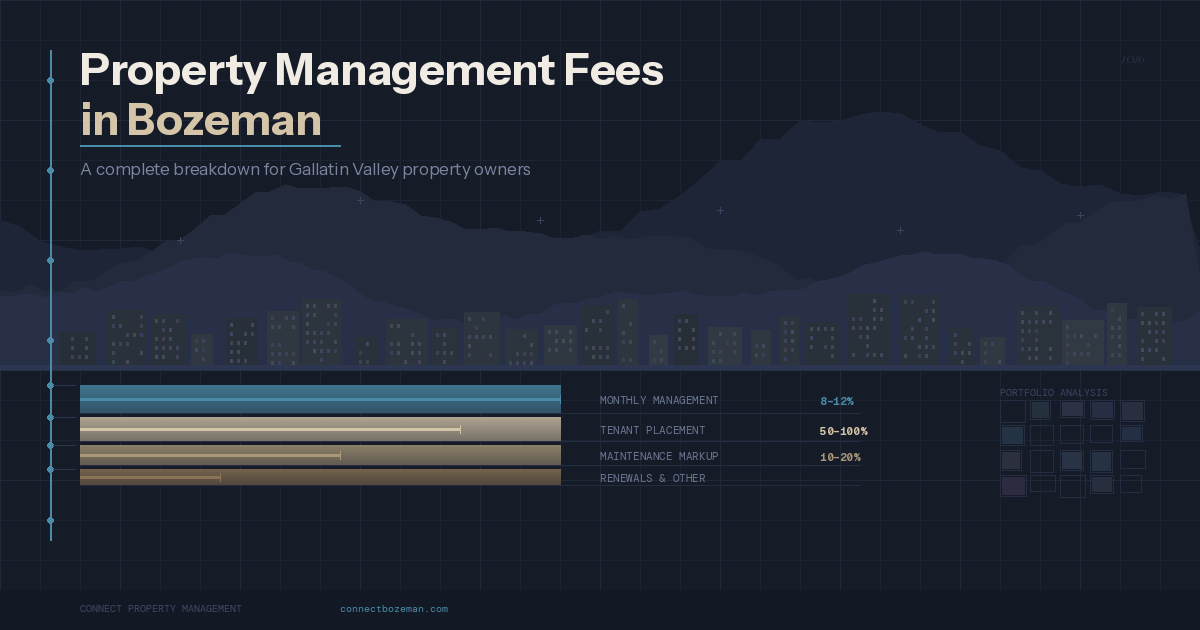
Percentage-based pricing is the most common structure in the Bozeman market. Firms typically charge between 8% and 12% of monthly rent collected. On a property renting for $2,000 per month, that translates to $160–$240 per month. The rate usually scales down as you add more units — owners with five or more doors often negotiate better terms.
Flat-fee pricing is less common locally but growing in popularity. Flat fees in Montana generally range from $100 to $300 per property per month regardless of rent amount. This model favors owners of higher-rent properties, since the fee doesn't increase with rent.
Hybrid models combine a reduced percentage with a fixed administrative fee — for example, 5% of rent plus a $75 monthly admin fee. This structure is becoming more common nationally, though few Bozeman firms have adopted it yet.
One critical detail: confirm whether the fee is calculated on rent collected or rent charged. If your property sits vacant and the fee is based on rent charged, you're paying management fees on income you're not receiving.
The Full Fee Breakdown
The monthly management fee is only one component. Here's what else to expect.
Leasing and Tenant Placement Fee
This is the fee charged each time a new tenant is placed in your property. In the Bozeman market, expect to pay between 50% and 100% of one month's rent. On a $2,000/month unit, that's $1,000–$2,000.
This fee covers marketing the vacancy, conducting showings, screening applicants (credit, criminal, rental history, income verification), preparing the lease, and coordinating move-in. Some firms include professional photography and virtual tours; others charge separately.
This is often the largest single expense in a given year, especially if turnover is high. Ask whether the fee is prorated or refunded if a tenant breaks their lease within the first few months.
Lease Renewal Fee
When an existing tenant renews, most managers charge $100–$300 for the renewal paperwork and any rent adjustment negotiations. Some firms waive this fee entirely, viewing retention as part of their core service. Others charge a percentage of one month's rent.
Since renewals cost far less than new placements, a company that invests in tenant retention will save you significantly over time. Ask about renewal rates — a firm that retains 70% of tenants versus 50% is saving you thousands annually in placement fees and vacancy loss.
Maintenance Coordination Markup
Most property managers mark up vendor invoices by 10% to 20% to cover the time spent coordinating repairs, vetting contractors, and managing quality control. On a $500 plumbing repair, expect a $50–$100 markup.
Some firms employ in-house maintenance teams. This can be more cost-effective for routine work (changing locks, fixing leaky faucets, minor drywall repair) but may be more expensive for specialized trades. Ask whether in-house work is billed at an hourly rate or flat rate, and what that rate is.
In the Bozeman market specifically, contractor availability is tight — especially during peak building season (May through October). A property manager with established vendor relationships and priority scheduling can prevent a minor issue from becoming a costly delay.
Setup and Onboarding Fee
A one-time charge of $0–$500 when you first bring a property under management. This typically covers an initial property inspection, documenting the property's condition, setting up accounting, and onboarding the property into the management software.
Some firms waive this fee to win new business. Whether it's charged or not, make sure the onboarding process includes a thorough documented inspection — that documentation protects you during move-out disputes.
Vacancy Fee
Some managers charge a reduced fee during vacant periods to cover ongoing property monitoring, marketing, and showing coordination. Others charge nothing during vacancy. This is a negotiation point — push for no vacancy fee, or at minimum a significantly reduced rate.
Eviction Fee
If an eviction becomes necessary, most firms charge an additional fee to manage the legal process. This typically ranges from $200–$500 plus court costs and any attorney fees. Some include basic eviction management in their standard agreement; others treat it as entirely separate.
What a Typical Year Actually Costs: A Real Example
Abstract fee percentages are hard to evaluate. Here's what a year of professional management looks like in practice for a typical Bozeman rental.
Assume a single-family home renting at $2,200 per month with a 10% management fee and one tenant turnover during the year:
- Monthly management fee: $220 x 12 months = $2,640
- Tenant placement fee (one turnover): 75% of one month's rent = $1,650
- Lease renewal fee: $0 (tenant turned over, no renewal this year)
- Maintenance markup: Approximately $300–$500 across the year (assuming $2,500–$3,500 in total maintenance spend with a 15% markup)
- Setup fee: $0 (waived, existing client)
Total annual cost: approximately $4,590–$4,790
Against gross annual rent of $26,400, that's roughly 17%–18% of gross income going to management. That number sounds high until you factor in what self-management actually costs: your time screening tenants, coordinating repairs (good luck finding a plumber in Bozeman in July), handling after-hours emergencies, staying current on Montana landlord-tenant law, and dealing with lease enforcement.
The math shifts even more in favor of professional management when you account for vacancy. If a manager fills your unit two weeks faster than you would have on your own, that's $1,100 in recovered rent — nearly half the annual management fee paid back immediately.
What Drives Price Differences in Bozeman
Not all 8% management fees are created equal. Several factors explain why one firm charges more or less than another.
Portfolio size and property type. A firm managing 500 units can operate more efficiently than one managing 50. HOA management, commercial properties, and luxury units each carry different overhead. Student housing near MSU has different demands than a single-family home in Belgrade.
Service scope. A lower fee often means a narrower service package. Compare what's included: Does the base fee cover inspections? How many per year? Is rent collection included, or is there a per-transaction charge? Are financial reports and year-end tax documentation included?
Technology and reporting. Firms that invest in online portals for rent payment, maintenance requests, and owner reporting carry higher overhead but provide significantly better visibility into your property's performance. If you're managing remotely, this matters.
Market knowledge. Bozeman's rental market has specific dynamics — seasonal demand driven by MSU enrollment cycles, competition from short-term rentals, and a construction boom that's adding supply but not keeping pace with population growth. A manager who understands these patterns will price your property correctly and minimize vacancy.
How to Evaluate a Property Manager Beyond the Fee
The cheapest option almost never delivers the best return. Here's what to focus on instead.
Net owner income, not fee percentage. A manager charging 10% who keeps your property occupied at $2,100/month generates more net income than one charging 8% who prices it at $1,900 and takes three weeks longer to fill vacancies. Run the math on an annual basis, including placement fees and estimated vacancy.
Vacancy rate and days-on-market. Ask for their portfolio averages. A strong Bozeman property manager should be filling units within 15–30 days, with vacancy rates under 5%.
Tenant retention rate. High turnover kills returns. Every turnover costs you a placement fee, potential renovation expenses, and 2–4 weeks of lost rent. A manager who retains 70%+ of tenants annually is saving you real money.
Maintenance response time. Montana law requires landlords to address habitability issues promptly. A manager with slow response times creates legal exposure and tenant dissatisfaction. Ask about their average response time and after-hours emergency process.
Communication cadence. You should receive monthly financial statements, immediate notification of material issues (lease violations, major repairs, vacancy), and at minimum an annual property assessment. If a firm can't articulate their communication process, that's a red flag.
Licensing and insurance. Montana requires property managers to hold a property management license. Verify the license is active and that the firm carries adequate errors and omissions insurance. This protects you if the manager makes a mistake that results in financial loss — and it's a basic indicator of professionalism.
Frequently Asked Questions
What is the average property management fee in Bozeman? Most Bozeman property management companies charge between 8% and 12% of monthly rent collected. For a property renting at $2,000 per month, that's $160–$240 per month for the base management fee. Additional fees for leasing, maintenance coordination, and renewals are typically separate.
Is it worth hiring a property manager in Bozeman? For most owners, yes — particularly if you own multiple units, don't live locally, or don't want to handle tenant calls, maintenance, and legal compliance yourself. A good property manager typically pays for their fee through better pricing, lower vacancy, and reduced maintenance costs. The Bozeman market's tight contractor availability and seasonal demand patterns make professional management especially valuable.
What should I look for in a Bozeman property management contract? Read the termination clause carefully — avoid contracts that lock you in for more than 90 days or charge early termination penalties. Verify what's included in the base fee versus charged separately. Confirm how maintenance is handled and what the markup is. Ensure the contract specifies how often you receive financial reports and how funds are disbursed.
Do property managers in Bozeman handle short-term rentals? Some do, though short-term rental management typically costs more — 15% to 25% of revenue — due to the higher operational intensity (guest turnover, cleaning, listing management, dynamic pricing). Bozeman also has specific short-term rental regulations that require compliance, so confirm your manager is familiar with current city and county rules.
Can I negotiate property management fees? Yes. Multi-unit owners, owners with newer or low-maintenance properties, and owners willing to sign longer contracts often have leverage. The most productive negotiation isn't always on the percentage — sometimes it's on waiving the setup fee, reducing the placement fee, or eliminating the vacancy fee.
Connect Property Management manages over $500 million in residential and commercial assets across the Gallatin Valley. If you're evaluating property management options in Bozeman, Belgrade, or the surrounding area, contact our team for a customized management proposal.

